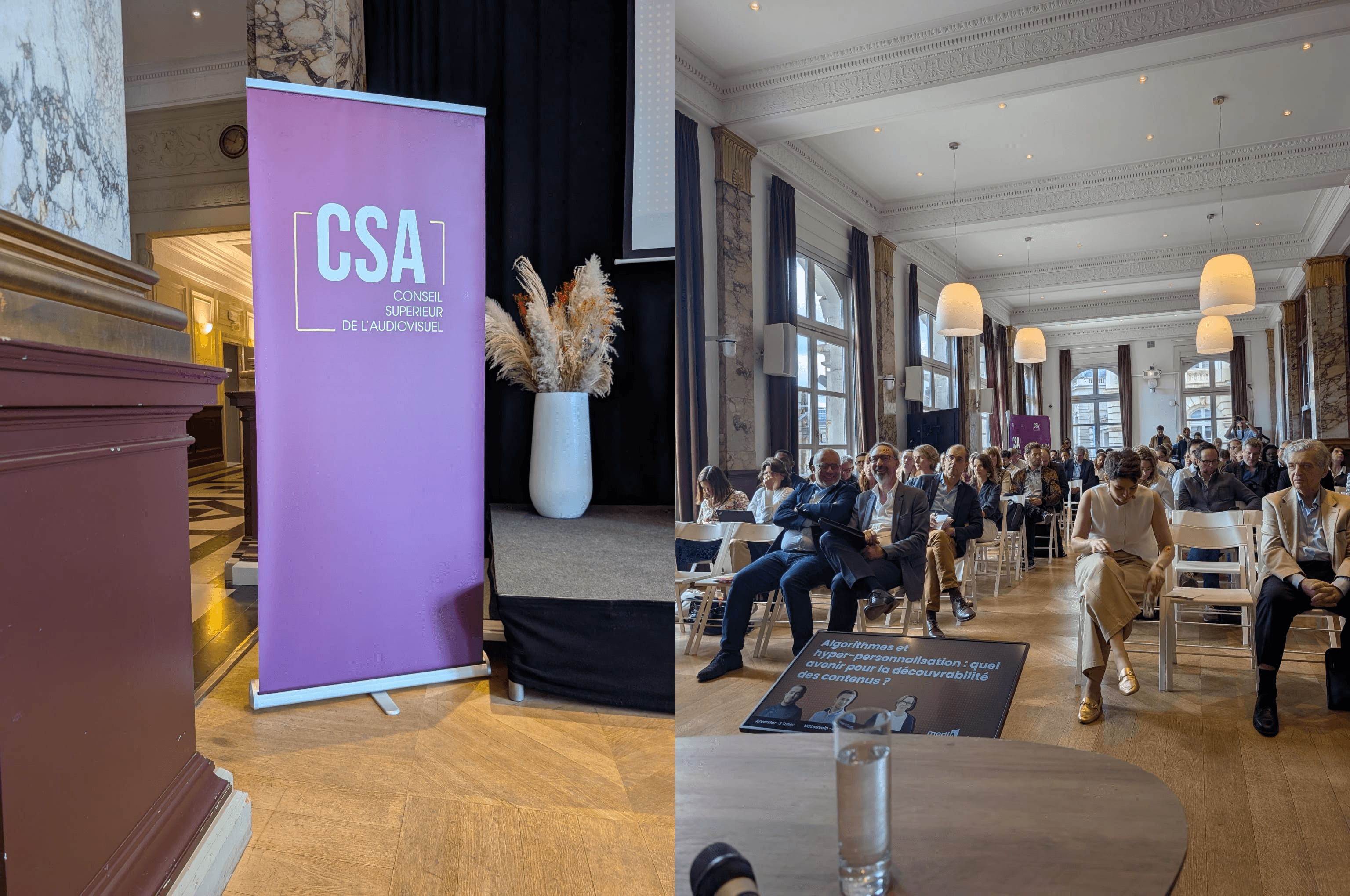
CSA ‘Media Miroirs’ Conference in Brussels
Some notes on our discussions
I had the pleasure of taking part in a round-table discussion in early June at the invitation of the Belgian CSA. Moderated by Marie Vanoost, Director of the Studies and Research Department, this discussion took place alongside Arnaud Claes, a postdoctoral researcher at UCLouvain. One of the main aims of the day was to address the issue of algorithmic personalisation on streaming services and to draw lessons from this for local media, particularly those serving the public interest. Here are some of the points that were discussed.
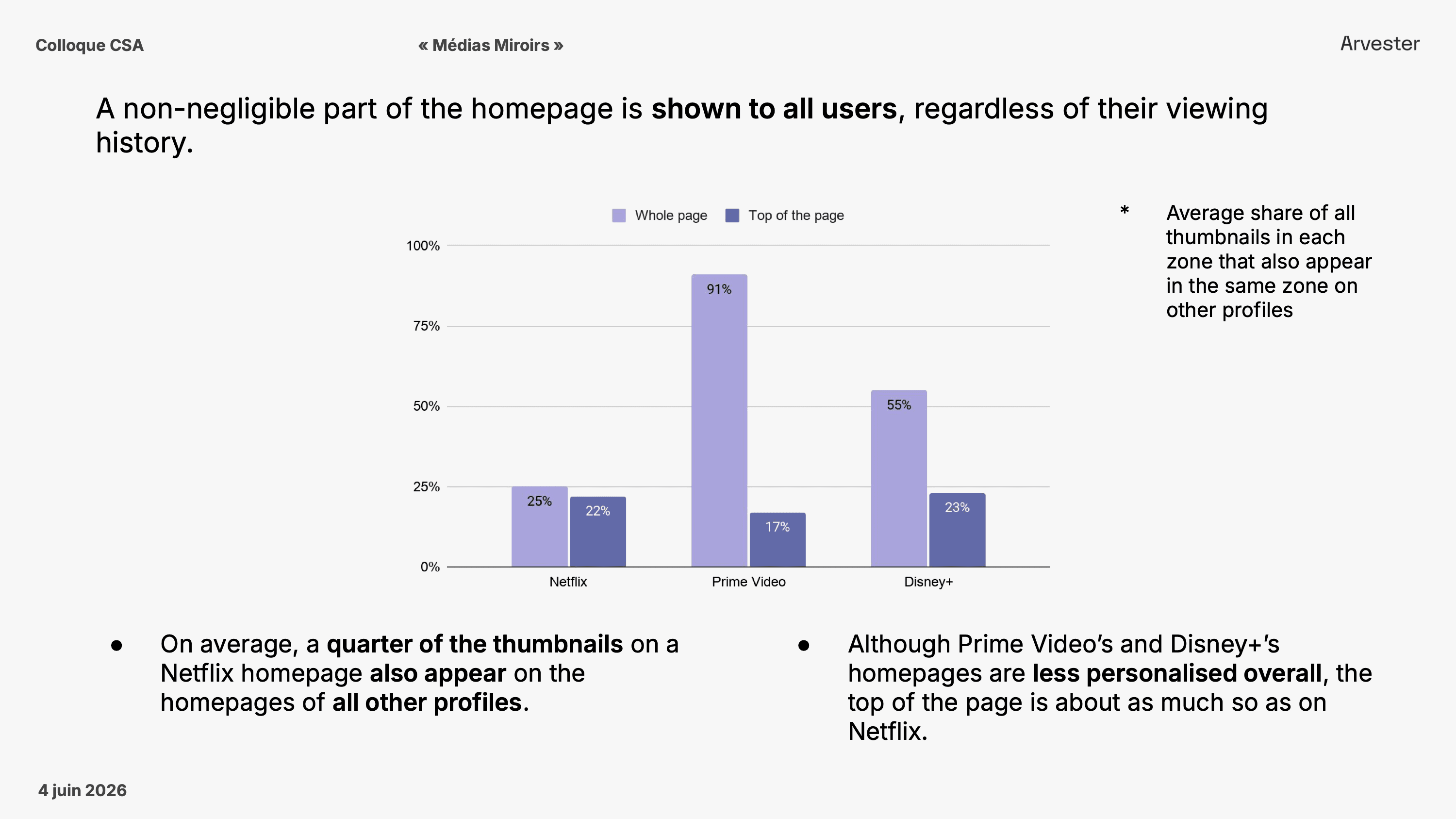
For us, this event was first and foremost an opportunity to provide some general stats regarding discoverability, putting availability (the catalogue) into perspective alongside what is actually ‘discoverable’ via the homepage. It was also an opportunity to share the results of a study we recently carried out on the personalisation of the homepages of Netflix, Prime Video and Disney+ in France. Contrary to what one might expect, our figures show that these services are ultimately less personalised than they might appear to be and that a high degree of editorial curation remains. This phenomenon is particularly evident on Netflix – a service renowned for being the most personalised in the world – where, on average, a quarter of the thumbnails on a home page appear exactly the same as those on every other user’s home page, regardless of their viewing history.
Another observation we made during this discussion was the significant transformation of video-on-demand services, which are becoming less and less ‘audiovisual’ with the arrival of video games, concerts, live events and even short-form video streams. This development risks complicating their regulation, particularly with regards to definitions, as the line between video-sharing platforms and traditional video-on-demand services is becoming increasingly difficult to draw. This point appears, moreover, to have been highlighted by the Arcom, which, as part of its contributions to the European Commission’s public consultation on the revision of the Audiovisual Media Services Directive (AVMSD), suggests reclassifying so-called audiovisual media services as ‘user interface providers’. Although it is unlikely that this definition will be adopted, the aim would be to extend the application of funding and broadcasting obligations to all platforms, thereby encompassing YouTube. The latter is, in fact, the subject of fierce criticism from the sector, which denounces a regulatory imbalance compared with traditional publishers and broadcasters, who are subject to far heavier obligations.
Finally, we revisited the new distribution strategies of the established broadcasters, which now advocate aggregation on a massive scale (TF1 on Netflix, Arte on TF1, France Télévisions on Prime Video, etc.). This provided an opportunity to point out – whilst tempering the general enthusiasm somewhat – that aggregation is not without risk for the aggregated catalogues, which, on the face of it, derive only minimal benefit in terms of audience figures. This observation is, moreover, in line with the analysis shared during the previous round-table discussion by Jean-Paul Philippot, Director-General of RTBF, who notably highlighted revealing figures showing that views of Arte’s content on YouTube ultimately account for barely 2 per cent of its total traffic. In this era of hyper-distribution, we are convinced that maintaining and developing ‘home’ interfaces is more important than ever, as only a network’s own interface is capable of truly conveying its brand image to the user.
Many thanks to the CSA teams for their hospitality, and in particular to Karim Ibourki, Marie Vanoost and Emma du Quesne.